This article covers Singular Value Decomposition (SVD) and related matrix decompositions in Go. SVD is fundamental to many applications including dimensionality reduction, pseudoinverse computation, and low-rank approximation.
Linear Algebra: Golang Series - View all articles in this series.
Previous articles in this series:
- Linear Algebra in Go: Vectors and Basic Operations
- Linear Algebra in Go: Matrix Fundamentals
- Linear Algebra in Go: Solving Linear Systems
- Linear Algebra in Go: Eigenvalue Problems
This continues from Part 4: Eigenvalue Problems.
SVD Decomposition
The SVD factors a matrix as $\boldsymbol{A} = \boldsymbol{U}\boldsymbol{\Sigma}\boldsymbol{V}^T$:
package main

import (
    "fmt"
    "gonum.org/v1/gonum/mat"
)

func main() {
    A := mat.NewDense(4, 3, []float64{
        1, 2, 3,
        4, 5, 6,
        7, 8, 9,
        10, 11, 12,
    })

    var svd mat.SVD
    ok := svd.Factorize(A, mat.SVDThin)
    if !ok {
        fmt.Println("SVD factorization failed")
        return
    }

    // Get singular values
    values := svd.Values(nil)
    fmt.Println("Singular values:")
    for i, v := range values {
        fmt.Printf("  σ%d = %.6f\n", i+1, v)
    }

    // Get U and V matrices
    var U, V mat.Dense
    svd.UTo(&U)
    svd.VTo(&V)

    fmt.Println("\nU matrix:")
    fmt.Printf("%v\n", mat.Formatted(&U, mat.Prefix("  ")))

    fmt.Println("\nV matrix:")
    fmt.Printf("%v\n", mat.Formatted(&V, mat.Prefix("  ")))
}
Visualizing Singular Value Decay
Singular values typically decay rapidly, which enables low-rank approximations:
package main

import (
    "fmt"
    "math"

    "gonum.org/v1/plot"
    "gonum.org/v1/plot/plotter"
    "gonum.org/v1/plot/vg"
    "image/color"
)

func main() {
    p := plot.New()
    p.Title.Text = "Singular Value Decay"
    p.Y.Label.Text = "Singular Value"
    p.X.Label.Text = "Index"

    // Simulate typical singular value decay
    n := 15
    vals := make(plotter.Values, n)
    for i := 0; i < n; i++ {
        vals[i] = 50 * math.Exp(-0.3*float64(i))
    }

    bars, _ := plotter.NewBarChart(vals, vg.Points(20))
    bars.Color = color.RGBA{R: 66, G: 133, B: 244, A: 255}
    p.Add(bars)

    labels := make([]string, n)
    for i := 0; i < n; i++ {
        labels[i] = fmt.Sprintf("%d", i+1)
    }
    p.NominalX(labels...)

    p.Save(6*vg.Inch, 4*vg.Inch, "svd.png")
}
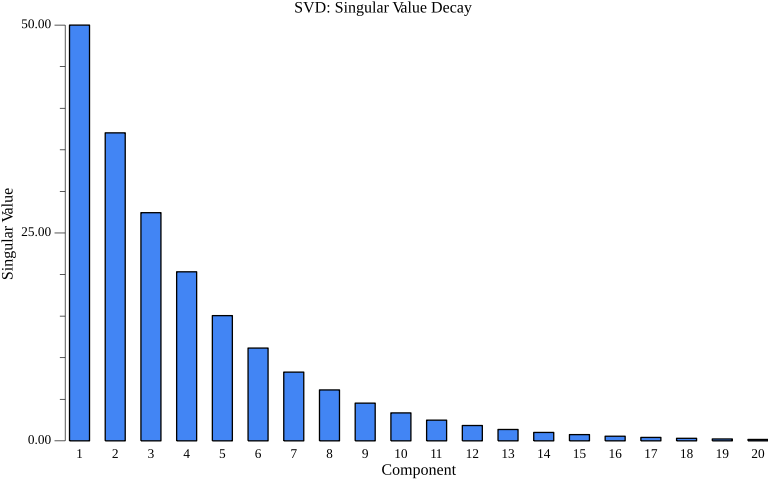
The rapid decay of singular values explains why low-rank approximations work well - most of the “information” is captured in the first few components.
Low-Rank Approximation
Keep only the top k singular values:
func lowRankApprox(A *mat.Dense, k int) *mat.Dense {
    var svd mat.SVD
    svd.Factorize(A, mat.SVDThin)

    values := svd.Values(nil)
    var U, V mat.Dense
    svd.UTo(&U)
    svd.VTo(&V)

    rows, cols := A.Dims()

    // Truncate to k components
    Uk := U.Slice(0, rows, 0, k).(*mat.Dense)
    Vk := V.Slice(0, cols, 0, k).(*mat.Dense)

    // Construct diagonal matrix with top k singular values
    Sk := mat.NewDiagDense(k, values[:k])

    // Compute U_k * S_k * V_k^T
    var temp mat.Dense
    temp.Mul(Uk, Sk)

    var result mat.Dense
    result.Mul(&temp, Vk.T())

    return &result
}

func lowRankExample() {
    A := mat.NewDense(5, 4, []float64{
        1, 2, 3, 4,
        5, 6, 7, 8,
        9, 10, 11, 12,
        13, 14, 15, 16,
        17, 18, 19, 20,
    })

    fmt.Println("Original matrix:")
    fmt.Printf("%v\n\n", mat.Formatted(A))

    for k := 1; k <= 3; k++ {
        Ak := lowRankApprox(A, k)
        diff := mat.NewDense(5, 4, nil)
        diff.Sub(A, Ak)
        error := mat.Norm(diff, 2)
        fmt.Printf("Rank-%d approximation error: %.6f\n", k, error)
    }
}
Pseudoinverse via SVD
Compute the Moore-Penrose pseudoinverse:
func pseudoinverse(A *mat.Dense) *mat.Dense {
    var svd mat.SVD
    svd.Factorize(A, mat.SVDThin)

    values := svd.Values(nil)
    var U, V mat.Dense
    svd.UTo(&U)
    svd.VTo(&V)

    rows, cols := A.Dims()
    minDim := min(rows, cols)

    // Invert non-zero singular values
    tol := 1e-10 * values[0]
    sInv := make([]float64, minDim)
    for i, s := range values {
        if s > tol {
            sInv[i] = 1.0 / s
        }
    }

    // A+ = V * S+ * U^T
    SInv := mat.NewDiagDense(minDim, sInv)

    var temp mat.Dense
    temp.Mul(&V, SInv)

    var pinv mat.Dense
    pinv.Mul(&temp, U.T())

    return &pinv
}

func min(a, b int) int {
    if a < b {
        return a
    }
    return b
}
QR Decomposition
Factor $\boldsymbol{A} = \boldsymbol{Q}\boldsymbol{R}$:
func qrDecomposition() {
    A := mat.NewDense(4, 3, []float64{
        1, 2, 3,
        4, 5, 6,
        7, 8, 10,
        10, 11, 13,
    })

    var qr mat.QR
    qr.Factorize(A)

    var Q, R mat.Dense
    qr.QTo(&Q)
    qr.RTo(&R)

    fmt.Println("Q (orthogonal):")
    fmt.Printf("%v\n\n", mat.Formatted(&Q, mat.Prefix("  ")))

    fmt.Println("R (upper triangular):")
    fmt.Printf("%v\n\n", mat.Formatted(&R, mat.Prefix("  ")))

    // Verify Q is orthogonal: Q^T * Q = I
    var QTQ mat.Dense
    QTQ.Mul(Q.T(), &Q)
    fmt.Println("Q^T * Q (should be identity):")
    fmt.Printf("%v\n", mat.Formatted(&QTQ, mat.Prefix("  ")))
}
Condition Number
Compute condition number using SVD:
func conditionNumber(A *mat.Dense) float64 {
    var svd mat.SVD
    svd.Factorize(A, mat.SVDNone)

    values := svd.Values(nil)
    return values[0] / values[len(values)-1]
}

func conditionExample() {
    // Well-conditioned
    A := mat.NewDense(3, 3, []float64{
        1, 0, 0,
        0, 2, 0,
        0, 0, 3,
    })

    // Ill-conditioned
    B := mat.NewDense(3, 3, []float64{
        1, 1, 1,
        1, 1, 1.0001,
        1, 1.0001, 1,
    })

    fmt.Printf("Well-conditioned matrix: κ = %.2f\n", conditionNumber(A))
    fmt.Printf("Ill-conditioned matrix: κ = %.2e\n", conditionNumber(B))
}
Summary
This article covered:
- SVD decomposition: $\boldsymbol{A} = \boldsymbol{U}\boldsymbol{\Sigma}\boldsymbol{V}^T$
- Low-rank approximation using truncated SVD
- Pseudoinverse computation
- QR decomposition
- Condition number for numerical stability
Resources
Linear Algebra: Golang Series - View all articles in this series.
This blog post, titled: "Linear Algebra in Go: SVD and Decompositions: Linear Algebra in Go Part 5" by Craig Johnston, is licensed under a Creative Commons Attribution 4.0 International License.
