This article demonstrates building a regression library in Go from scratch using gonum: ordinary least squares, ridge regression, and cross-validation.
Linear Algebra: Golang Series - View all articles in this series.
Previous articles in this series:
- Linear Algebra in Go: Vectors and Basic Operations
- Linear Algebra in Go: Matrix Fundamentals
- Linear Algebra in Go: Solving Linear Systems
- Linear Algebra in Go: Eigenvalue Problems
- Linear Algebra in Go: SVD and Decompositions
- Linear Algebra in Go: Statistics and Data Analysis
This continues from Part 6: Statistics and Data Analysis.
Linear Regression Structure
package regression

import (
    "gonum.org/v1/gonum/mat"
)

// LinearRegression implements OLS regression
type LinearRegression struct {
    Weights     *mat.VecDense
    Intercept   float64
    FitIntercept bool
}

// NewLinearRegression creates a new regression model
func NewLinearRegression(fitIntercept bool) *LinearRegression {
    return &LinearRegression{
        FitIntercept: fitIntercept,
    }
}
Fit Method
// Fit trains the model using ordinary least squares
func (lr *LinearRegression) Fit(X *mat.Dense, y *mat.VecDense) error {
    rows, cols := X.Dims()

    // Add intercept column if needed
    var Xb *mat.Dense
    if lr.FitIntercept {
        Xb = mat.NewDense(rows, cols+1, nil)
        for i := 0; i < rows; i++ {
            Xb.Set(i, 0, 1.0)  // Intercept column
            for j := 0; j < cols; j++ {
                Xb.Set(i, j+1, X.At(i, j))
            }
        }
    } else {
        Xb = X
    }

    // Solve normal equations: (X^T X) w = X^T y
    _, nCols := Xb.Dims()
    var XtX mat.Dense
    XtX.Mul(Xb.T(), Xb)

    var Xty mat.VecDense
    Xty.MulVec(Xb.T(), y)

    // Solve for weights
    lr.Weights = mat.NewVecDense(nCols, nil)
    err := lr.Weights.SolveVec(&XtX, &Xty)
    if err != nil {
        return err
    }

    // Extract intercept if fitted
    if lr.FitIntercept {
        lr.Intercept = lr.Weights.AtVec(0)
        // Remove intercept from weights
        newWeights := mat.NewVecDense(nCols-1, nil)
        for i := 1; i < nCols; i++ {
            newWeights.SetVec(i-1, lr.Weights.AtVec(i))
        }
        lr.Weights = newWeights
    }

    return nil
}
Predict Method
// Predict generates predictions for new data
func (lr *LinearRegression) Predict(X *mat.Dense) *mat.VecDense {
    rows, _ := X.Dims()

    predictions := mat.NewVecDense(rows, nil)
    predictions.MulVec(X, lr.Weights)

    // Add intercept
    if lr.FitIntercept {
        for i := 0; i < rows; i++ {
            predictions.SetVec(i, predictions.AtVec(i)+lr.Intercept)
        }
    }

    return predictions
}
Visualizing Regression
Here’s a visualization of a linear regression fit:
package main

import (
    "fmt"
    "image/color"
    "math/rand"

    "gonum.org/v1/gonum/stat"
    "gonum.org/v1/plot"
    "gonum.org/v1/plot/plotter"
    "gonum.org/v1/plot/vg"
)

func main() {
    rand.Seed(42)
    p := plot.New()
    p.Title.Text = "Linear Regression with Gonum"
    p.X.Label.Text = "X"
    p.Y.Label.Text = "Y"

    n := 40
    pts := make(plotter.XYs, n)
    xData := make([]float64, n)
    yData := make([]float64, n)

    for i := 0; i < n; i++ {
        x := float64(i) / 4.0
        y := 2 + 1.5*x + rand.NormFloat64()*1.5
        pts[i] = plotter.XY{X: x, Y: y}
        xData[i] = x
        yData[i] = y
    }

    scatter, _ := plotter.NewScatter(pts)
    scatter.GlyphStyle.Color = color.RGBA{R: 66, G: 133, B: 244, A: 200}
    scatter.GlyphStyle.Radius = vg.Points(5)

    alpha, beta := stat.LinearRegression(xData, yData, nil, false)
    linePts := plotter.XYs{{X: 0, Y: alpha}, {X: 10, Y: alpha + 10*beta}}
    line, _ := plotter.NewLine(linePts)
    line.Color = color.RGBA{R: 234, G: 67, B: 53, A: 255}
    line.Width = vg.Points(2)

    p.Add(scatter, line)
    p.Legend.Add("Data", scatter)
    p.Legend.Add(fmt.Sprintf("y = %.1f + %.1fx", alpha, beta), line)
    p.Legend.Top = true

    p.Save(6*vg.Inch, 5*vg.Inch, "regression.png")
}
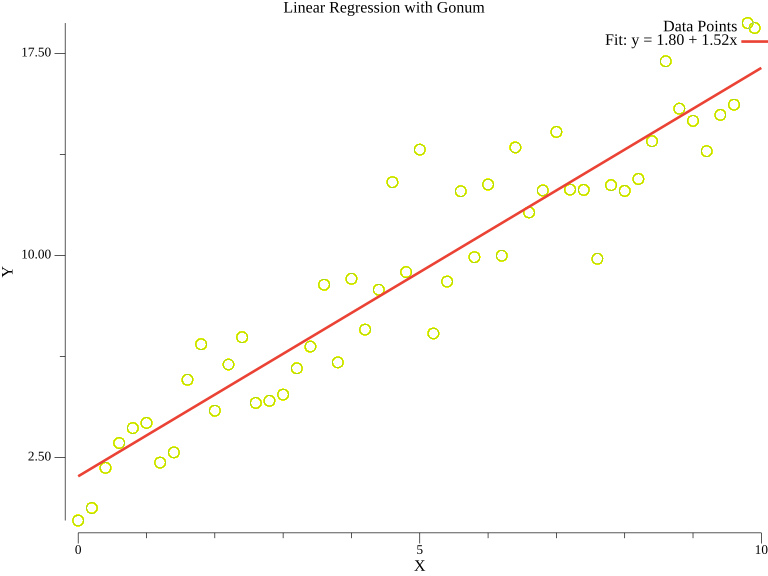
The blue points represent observed data, and the red line shows the fitted regression model. The legend displays the learned equation.
Ridge Regression
// RidgeRegression implements L2-regularized regression
type RidgeRegression struct {
    Weights      *mat.VecDense
    Intercept    float64
    Alpha        float64
    FitIntercept bool
}

func NewRidgeRegression(alpha float64, fitIntercept bool) *RidgeRegression {
    return &RidgeRegression{
        Alpha:        alpha,
        FitIntercept: fitIntercept,
    }
}

func (rr *RidgeRegression) Fit(X *mat.Dense, y *mat.VecDense) error {
    rows, cols := X.Dims()

    // Add intercept column
    var Xb *mat.Dense
    if rr.FitIntercept {
        Xb = mat.NewDense(rows, cols+1, nil)
        for i := 0; i < rows; i++ {
            Xb.Set(i, 0, 1.0)
            for j := 0; j < cols; j++ {
                Xb.Set(i, j+1, X.At(i, j))
            }
        }
    } else {
        Xb = X
    }

    _, nCols := Xb.Dims()

    // (X^T X + alpha * I) w = X^T y
    var XtX mat.Dense
    XtX.Mul(Xb.T(), Xb)

    // Add regularization term (skip intercept)
    for i := 0; i < nCols; i++ {
        if rr.FitIntercept && i == 0 {
            continue  // Don't regularize intercept
        }
        XtX.Set(i, i, XtX.At(i, i)+rr.Alpha)
    }

    var Xty mat.VecDense
    Xty.MulVec(Xb.T(), y)

    rr.Weights = mat.NewVecDense(nCols, nil)
    err := rr.Weights.SolveVec(&XtX, &Xty)
    if err != nil {
        return err
    }

    if rr.FitIntercept {
        rr.Intercept = rr.Weights.AtVec(0)
        newWeights := mat.NewVecDense(nCols-1, nil)
        for i := 1; i < nCols; i++ {
            newWeights.SetVec(i-1, rr.Weights.AtVec(i))
        }
        rr.Weights = newWeights
    }

    return nil
}
Cross-Validation
// CrossValidate performs k-fold cross-validation
func CrossValidate(X *mat.Dense, y *mat.VecDense, k int) []float64 {
    rows, _ := X.Dims()
    foldSize := rows / k
    scores := make([]float64, k)

    for fold := 0; fold < k; fold++ {
        // Split data
        testStart := fold * foldSize
        testEnd := testStart + foldSize

        // Create train/test splits
        XTrain, yTrain, XTest, yTest := splitData(X, y, testStart, testEnd)

        // Train model
        model := NewLinearRegression(true)
        model.Fit(XTrain, yTrain)

        // Evaluate
        predictions := model.Predict(XTest)
        scores[fold] = rSquared(yTest, predictions)
    }

    return scores
}

func rSquared(yTrue, yPred *mat.VecDense) float64 {
    n := yTrue.Len()

    // Mean of y
    var sum float64
    for i := 0; i < n; i++ {
        sum += yTrue.AtVec(i)
    }
    mean := sum / float64(n)

    // SS_res and SS_tot
    var ssRes, ssTot float64
    for i := 0; i < n; i++ {
        diff := yTrue.AtVec(i) - yPred.AtVec(i)
        ssRes += diff * diff
        diff = yTrue.AtVec(i) - mean
        ssTot += diff * diff
    }

    return 1 - ssRes/ssTot
}
Usage Example
func main() {
    // Generate sample data
    X := mat.NewDense(100, 3, nil)
    y := mat.NewVecDense(100, nil)

    for i := 0; i < 100; i++ {
        x1 := rand.Float64() * 10
        x2 := rand.Float64() * 10
        x3 := rand.Float64() * 10
        X.Set(i, 0, x1)
        X.Set(i, 1, x2)
        X.Set(i, 2, x3)
        y.SetVec(i, 2 + 3*x1 - 1.5*x2 + 0.5*x3 + rand.NormFloat64())
    }

    // Fit OLS
    ols := NewLinearRegression(true)
    ols.Fit(X, y)
    fmt.Printf("OLS Weights: %v\n", ols.Weights)
    fmt.Printf("OLS Intercept: %.4f\n", ols.Intercept)

    // Fit Ridge
    ridge := NewRidgeRegression(1.0, true)
    ridge.Fit(X, y)
    fmt.Printf("Ridge Weights: %v\n", ridge.Weights)

    // Cross-validation
    scores := CrossValidate(X, y, 5)
    fmt.Printf("CV R² scores: %v\n", scores)
}
Summary
This article built:
- LinearRegression using normal equations
- RidgeRegression with L2 regularization
- Cross-validation for model evaluation
- R-squared metric computation
Resources
Linear Algebra: Golang Series - View all articles in this series.
This blog post, titled: "Linear Algebra in Go: Building a Regression Library: Linear Algebra in Go Part 7" by Craig Johnston, is licensed under a Creative Commons Attribution 4.0 International License.
