This article implements neural network foundations in Go using gonum: a perceptron, forward propagation, and backpropagation from scratch.
Linear Algebra: Golang Series - View all articles in this series.
Previous articles in this series:
- Linear Algebra in Go: Vectors and Basic Operations
- Linear Algebra in Go: Matrix Fundamentals
- Linear Algebra in Go: Solving Linear Systems
- Linear Algebra in Go: Eigenvalue Problems
- Linear Algebra in Go: SVD and Decompositions
- Linear Algebra in Go: Statistics and Data Analysis
- Linear Algebra in Go: Building a Regression Library
- Linear Algebra in Go: PCA Implementation
This continues from Part 8: PCA Implementation.
§Perceptron
The simplest neural network unit:
package nn

import (
    "math"
    "gonum.org/v1/gonum/mat"
)

// Perceptron implements a single-layer perceptron
type Perceptron struct {
    Weights      *mat.VecDense
    Bias         float64
    LearningRate float64
}

// NewPerceptron creates a new perceptron
func NewPerceptron(nFeatures int, lr float64) *Perceptron {
    weights := mat.NewVecDense(nFeatures, nil)
    // Initialize with small random values
    for i := 0; i < nFeatures; i++ {
        weights.SetVec(i, (rand.Float64()-0.5)*0.1)
    }
    return &Perceptron{
        Weights:      weights,
        Bias:         0,
        LearningRate: lr,
    }
}

// Predict returns the perceptron output
func (p *Perceptron) Predict(x *mat.VecDense) int {
    sum := mat.Dot(p.Weights, x) + p.Bias
    if sum >= 0 {
        return 1
    }
    return 0
}

// Train updates weights based on a single sample
func (p *Perceptron) Train(x *mat.VecDense, target int) {
    prediction := p.Predict(x)
    error := float64(target - prediction)

    // Update weights: w = w + lr * error * x
    for i := 0; i < p.Weights.Len(); i++ {
        p.Weights.SetVec(i, p.Weights.AtVec(i)+p.LearningRate*error*x.AtVec(i))
    }
    p.Bias += p.LearningRate * error
}

// Fit trains on a dataset for multiple epochs
func (p *Perceptron) Fit(X *mat.Dense, y []int, epochs int) []float64 {
    rows, _ := X.Dims()
    errors := make([]float64, epochs)

    for epoch := 0; epoch < epochs; epoch++ {
        epochErrors := 0
        for i := 0; i < rows; i++ {
            x := mat.NewVecDense(X.RawRowView(i))
            prediction := p.Predict(x)
            if prediction != y[i] {
                epochErrors++
            }
            p.Train(x, y[i])
        }
        errors[epoch] = float64(epochErrors) / float64(rows)
    }
    return errors
}
§Activation Functions
Common activation functions and their derivatives:
// Sigmoid activation
func sigmoid(x float64) float64 {
    return 1.0 / (1.0 + math.Exp(-x))
}

func sigmoidDerivative(x float64) float64 {
    s := sigmoid(x)
    return s * (1 - s)
}

// ReLU activation
func relu(x float64) float64 {
    if x > 0 {
        return x
    }
    return 0
}

func reluDerivative(x float64) float64 {
    if x > 0 {
        return 1
    }
    return 0
}

// Tanh activation
func tanh(x float64) float64 {
    return math.Tanh(x)
}

func tanhDerivative(x float64) float64 {
    t := math.Tanh(x)
    return 1 - t*t
}

// Apply activation to matrix
func applyActivation(m *mat.Dense, fn func(float64) float64) *mat.Dense {
    rows, cols := m.Dims()
    result := mat.NewDense(rows, cols, nil)
    for i := 0; i < rows; i++ {
        for j := 0; j < cols; j++ {
            result.Set(i, j, fn(m.At(i, j)))
        }
    }
    return result
}
§Multi-Layer Network
A simple feedforward network:
// Layer represents a single neural network layer
type Layer struct {
    Weights *mat.Dense
    Bias    *mat.VecDense
    Input   *mat.Dense  // Cached for backprop
    Output  *mat.Dense  // Cached for backprop
    Z       *mat.Dense  // Pre-activation values
}

// NeuralNetwork represents a multi-layer network
type NeuralNetwork struct {
    Layers       []*Layer
    LearningRate float64
}

// NewNeuralNetwork creates a network with given layer sizes
func NewNeuralNetwork(sizes []int, lr float64) *NeuralNetwork {
    layers := make([]*Layer, len(sizes)-1)

    for i := 0; i < len(sizes)-1; i++ {
        inputSize := sizes[i]
        outputSize := sizes[i+1]

        // Xavier initialization
        scale := math.Sqrt(2.0 / float64(inputSize+outputSize))
        weights := mat.NewDense(inputSize, outputSize, nil)
        for r := 0; r < inputSize; r++ {
            for c := 0; c < outputSize; c++ {
                weights.Set(r, c, (rand.Float64()-0.5)*2*scale)
            }
        }

        bias := mat.NewVecDense(outputSize, nil)

        layers[i] = &Layer{
            Weights: weights,
            Bias:    bias,
        }
    }

    return &NeuralNetwork{
        Layers:       layers,
        LearningRate: lr,
    }
}
§Forward Propagation
Compute network output:
// Forward performs forward propagation
func (nn *NeuralNetwork) Forward(X *mat.Dense) *mat.Dense {
    current := X

    for i, layer := range nn.Layers {
        layer.Input = current

        rows, _ := current.Dims()
        _, outputSize := layer.Weights.Dims()

        // Z = X @ W + b
        z := mat.NewDense(rows, outputSize, nil)
        z.Mul(current, layer.Weights)

        // Add bias to each row
        for r := 0; r < rows; r++ {
            for c := 0; c < outputSize; c++ {
                z.Set(r, c, z.At(r, c)+layer.Bias.AtVec(c))
            }
        }
        layer.Z = z

        // Apply activation (sigmoid for hidden, softmax for output)
        if i < len(nn.Layers)-1 {
            current = applyActivation(z, sigmoid)
        } else {
            current = softmax(z)
        }
        layer.Output = current
    }

    return current
}

// Softmax for output layer
func softmax(z *mat.Dense) *mat.Dense {
    rows, cols := z.Dims()
    result := mat.NewDense(rows, cols, nil)

    for r := 0; r < rows; r++ {
        // Find max for numerical stability
        max := z.At(r, 0)
        for c := 1; c < cols; c++ {
            if z.At(r, c) > max {
                max = z.At(r, c)
            }
        }

        // Compute exp and sum
        sum := 0.0
        for c := 0; c < cols; c++ {
            result.Set(r, c, math.Exp(z.At(r, c)-max))
            sum += result.At(r, c)
        }

        // Normalize
        for c := 0; c < cols; c++ {
            result.Set(r, c, result.At(r, c)/sum)
        }
    }

    return result
}
§Backpropagation
Compute gradients and update weights:
// Backward performs backpropagation
func (nn *NeuralNetwork) Backward(y *mat.Dense) {
    nLayers := len(nn.Layers)
    rows, _ := y.Dims()

    // Output layer error: dL/dZ = output - y (for softmax + cross-entropy)
    outputLayer := nn.Layers[nLayers-1]
    delta := mat.NewDense(rows, y.RawMatrix().Cols, nil)
    delta.Sub(outputLayer.Output, y)

    // Backpropagate through layers
    for i := nLayers - 1; i >= 0; i-- {
        layer := nn.Layers[i]

        // Compute gradients
        // dW = input.T @ delta
        inputRows, inputCols := layer.Input.Dims()
        _, deltaC := delta.Dims()
        dW := mat.NewDense(inputCols, deltaC, nil)
        dW.Mul(layer.Input.T(), delta)
        dW.Scale(1.0/float64(rows), dW)

        // dB = mean(delta, axis=0)
        dB := mat.NewVecDense(deltaC, nil)
        for c := 0; c < deltaC; c++ {
            sum := 0.0
            for r := 0; r < rows; r++ {
                sum += delta.At(r, c)
            }
            dB.SetVec(c, sum/float64(rows))
        }

        // Update weights and biases
        dW.Scale(nn.LearningRate, dW)
        layer.Weights.Sub(layer.Weights, dW)

        for c := 0; c < deltaC; c++ {
            layer.Bias.SetVec(c, layer.Bias.AtVec(c)-nn.LearningRate*dB.AtVec(c))
        }

        // Propagate error to previous layer
        if i > 0 {
            prevLayer := nn.Layers[i-1]
            _, prevCols := prevLayer.Output.Dims()

            // delta = delta @ W.T * sigmoid'(z)
            newDelta := mat.NewDense(rows, prevCols, nil)
            newDelta.Mul(delta, layer.Weights.T())

            // Element-wise multiply by sigmoid derivative
            for r := 0; r < rows; r++ {
                for c := 0; c < prevCols; c++ {
                    sigDeriv := sigmoidDerivative(prevLayer.Z.At(r, c))
                    newDelta.Set(r, c, newDelta.At(r, c)*sigDeriv)
                }
            }
            delta = newDelta
        }
    }
}
§Training Loop
Complete training with loss computation:
// CrossEntropyLoss computes cross-entropy loss
func CrossEntropyLoss(yPred, yTrue *mat.Dense) float64 {
    rows, cols := yTrue.Dims()
    loss := 0.0

    for r := 0; r < rows; r++ {
        for c := 0; c < cols; c++ {
            if yTrue.At(r, c) > 0 {
                pred := math.Max(yPred.At(r, c), 1e-15) // Avoid log(0)
                loss -= yTrue.At(r, c) * math.Log(pred)
            }
        }
    }

    return loss / float64(rows)
}

// Train trains the network
func (nn *NeuralNetwork) Train(X, y *mat.Dense, epochs int, batchSize int) []float64 {
    rows, _ := X.Dims()
    losses := make([]float64, epochs)

    for epoch := 0; epoch < epochs; epoch++ {
        epochLoss := 0.0
        nBatches := 0

        for start := 0; start < rows; start += batchSize {
            end := start + batchSize
            if end > rows {
                end = rows
            }

            // Get batch
            XBatch := X.Slice(start, end, 0, X.RawMatrix().Cols).(*mat.Dense)
            yBatch := y.Slice(start, end, 0, y.RawMatrix().Cols).(*mat.Dense)

            // Forward and backward pass
            output := nn.Forward(XBatch)
            nn.Backward(yBatch)

            epochLoss += CrossEntropyLoss(output, yBatch)
            nBatches++
        }

        losses[epoch] = epochLoss / float64(nBatches)
    }

    return losses
}

// Predict returns class predictions
func (nn *NeuralNetwork) Predict(X *mat.Dense) []int {
    output := nn.Forward(X)
    rows, cols := output.Dims()
    predictions := make([]int, rows)

    for r := 0; r < rows; r++ {
        maxIdx := 0
        maxVal := output.At(r, 0)
        for c := 1; c < cols; c++ {
            if output.At(r, c) > maxVal {
                maxVal = output.At(r, c)
                maxIdx = c
            }
        }
        predictions[r] = maxIdx
    }

    return predictions
}
§Usage Example
func main() {
    // XOR problem (simple non-linear example)
    X := mat.NewDense(4, 2, []float64{
        0, 0,
        0, 1,
        1, 0,
        1, 1,
    })

    // One-hot encoded labels
    y := mat.NewDense(4, 2, []float64{
        1, 0,  // Class 0
        0, 1,  // Class 1
        0, 1,  // Class 1
        1, 0,  // Class 0
    })

    // Create network: 2 inputs -> 4 hidden -> 2 outputs
    nn := NewNeuralNetwork([]int{2, 4, 2}, 0.5)

    // Train
    losses := nn.Train(X, y, 1000, 4)

    fmt.Println("Training loss (first 10 epochs):")
    for i := 0; i < 10 && i < len(losses); i++ {
        fmt.Printf("  Epoch %d: %.4f\n", i+1, losses[i])
    }
    fmt.Printf("  ...\n  Epoch %d: %.4f\n", len(losses), losses[len(losses)-1])

    // Predict
    predictions := nn.Predict(X)
    fmt.Println("\nPredictions:")
    for i, p := range predictions {
        fmt.Printf("  Input [%.0f, %.0f] -> Class %d\n",
            X.At(i, 0), X.At(i, 1), p)
    }
}
§Visualizing Training Progress
Plotting loss curves helps diagnose training:
package main

import (
    "image/color"
    "math"
    "math/rand"

    "gonum.org/v1/plot"
    "gonum.org/v1/plot/plotter"
    "gonum.org/v1/plot/vg"
)

func main() {
    rand.Seed(42)
    p := plot.New()
    p.Title.Text = "Neural Network Training"
    p.X.Label.Text = "Epoch"
    p.Y.Label.Text = "Loss"

    epochs := 80
    trainLoss := make(plotter.XYs, epochs)
    valLoss := make(plotter.XYs, epochs)

    for i := 0; i < epochs; i++ {
        t := float64(i)
        trainLoss[i] = plotter.XY{X: t, Y: 2.5*math.Exp(-0.05*t) + 0.1 + rand.Float64()*0.05}
        valLoss[i] = plotter.XY{X: t, Y: 2.5*math.Exp(-0.04*t) + 0.15 + rand.Float64()*0.08}
    }

    trainLine, _ := plotter.NewLine(trainLoss)
    trainLine.Color = color.RGBA{R: 66, G: 133, B: 244, A: 255}
    trainLine.Width = vg.Points(2)

    valLine, _ := plotter.NewLine(valLoss)
    valLine.Color = color.RGBA{R: 234, G: 67, B: 53, A: 255}
    valLine.Width = vg.Points(2)

    p.Add(trainLine, valLine)
    p.Legend.Add("Train", trainLine)
    p.Legend.Add("Validation", valLine)
    p.Legend.Top = true

    p.Save(6*vg.Inch, 4*vg.Inch, "neural-networks.png")
}
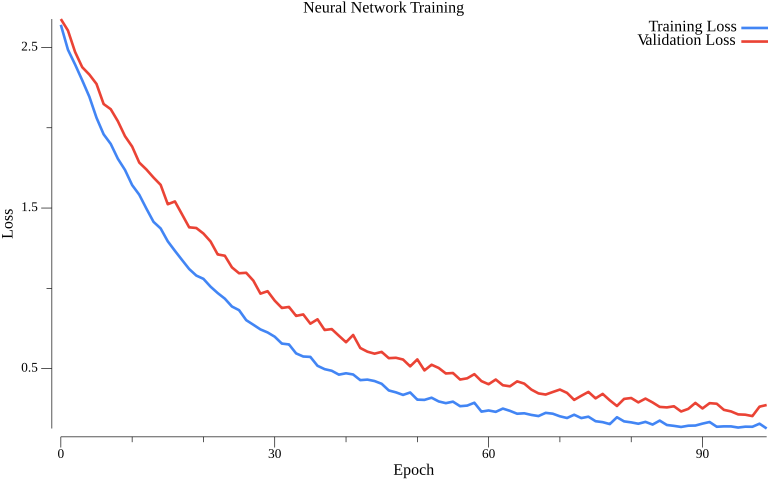
The training curve (blue) and validation curve (red) both decrease over time. The gap between them helps detect overfitting - a widening gap indicates the model memorizes training data rather than learning generalizable patterns.
§Gradient Checking
Verify backpropagation implementation:
// NumericalGradient computes gradient numerically
func NumericalGradient(nn *NeuralNetwork, X, y *mat.Dense, layerIdx, i, j int, eps float64) float64 {
    layer := nn.Layers[layerIdx]
    original := layer.Weights.At(i, j)

    // f(w + eps)
    layer.Weights.Set(i, j, original+eps)
    output1 := nn.Forward(X)
    loss1 := CrossEntropyLoss(output1, y)

    // f(w - eps)
    layer.Weights.Set(i, j, original-eps)
    output2 := nn.Forward(X)
    loss2 := CrossEntropyLoss(output2, y)

    // Restore
    layer.Weights.Set(i, j, original)

    return (loss1 - loss2) / (2 * eps)
}

func gradientCheck() {
    nn := NewNeuralNetwork([]int{2, 3, 2}, 0.1)

    X := mat.NewDense(2, 2, []float64{1, 2, 3, 4})
    y := mat.NewDense(2, 2, []float64{1, 0, 0, 1})

    // Compute analytical gradient via backprop
    nn.Forward(X)
    nn.Backward(y)

    // Compare with numerical gradient
    eps := 1e-5
    fmt.Println("Gradient check:")
    for l := 0; l < len(nn.Layers); l++ {
        layer := nn.Layers[l]
        rows, cols := layer.Weights.Dims()
        for i := 0; i < rows && i < 2; i++ {
            for j := 0; j < cols && j < 2; j++ {
                numerical := NumericalGradient(nn, X, y, l, i, j, eps)
                fmt.Printf("  Layer %d [%d,%d]: numerical=%.6f\n", l, i, j, numerical)
            }
        }
    }
}
§Summary
This article implemented:
- Perceptron single-layer classifier
- Activation functions with derivatives
- Forward propagation through multiple layers
- Backpropagation for gradient computation
- Training loop with cross-entropy loss
- Gradient checking for verification
§Resources
Linear Algebra: Golang Series - View all articles in this series.