This final article in the series covers high-performance computing techniques for linear algebra in Go: BLAS/LAPACK integration, parallel operations, memory optimization, and benchmarking.
Linear Algebra: Golang Series - View all articles in this series.
Previous articles in this series:
- Linear Algebra in Go: Vectors and Basic Operations
- Linear Algebra in Go: Matrix Fundamentals
- Linear Algebra in Go: Solving Linear Systems
- Linear Algebra in Go: Eigenvalue Problems
- Linear Algebra in Go: SVD and Decompositions
- Linear Algebra in Go: Statistics and Data Analysis
- Linear Algebra in Go: Building a Regression Library
- Linear Algebra in Go: PCA Implementation
- Linear Algebra in Go: Neural Network Foundations
This continues from Part 9: Neural Network Foundations.
BLAS and LAPACK
Gonum uses BLAS (Basic Linear Algebra Subprograms) under the hood. You can choose between pure Go and optimized C implementations.
Using OpenBLAS
For better performance, install OpenBLAS and use the netlib bindings:
# macOS
brew install openblas

# Ubuntu/Debian
apt-get install libopenblas-dev

# Build with netlib
go build -tags=netlib
Then import the netlib BLAS:
package main

import (
    "gonum.org/v1/gonum/blas/blas64"
    "gonum.org/v1/netlib/blas/netlib"
)

func init() {
    // Use OpenBLAS instead of native Go
    blas64.Use(netlib.Implementation{})
}
BLAS Levels
import "gonum.org/v1/gonum/blas/blas64"

// Level 1: Vector operations
func blasLevel1() {
    x := blas64.Vector{N: 4, Inc: 1, Data: []float64{1, 2, 3, 4}}
    y := blas64.Vector{N: 4, Inc: 1, Data: []float64{5, 6, 7, 8}}

    // Dot product
    dot := blas64.Dot(x, y)
    fmt.Printf("Dot product: %.2f\n", dot)

    // Norm
    norm := blas64.Nrm2(x)
    fmt.Printf("L2 norm: %.2f\n", norm)

    // Scale: y = alpha * x + y
    blas64.Axpy(2.0, x, y)
    fmt.Printf("After axpy: %v\n", y.Data)
}

// Level 2: Matrix-vector operations
func blasLevel2() {
    A := blas64.General{
        Rows:   2,
        Cols:   3,
        Stride: 3,
        Data:   []float64{1, 2, 3, 4, 5, 6},
    }
    x := blas64.Vector{N: 3, Inc: 1, Data: []float64{1, 1, 1}}
    y := blas64.Vector{N: 2, Inc: 1, Data: []float64{0, 0}}

    // y = alpha * A * x + beta * y
    blas64.Gemv(blas.NoTrans, 1.0, A, x, 0.0, y)
    fmt.Printf("A * x = %v\n", y.Data)
}

// Level 3: Matrix-matrix operations
func blasLevel3() {
    A := blas64.General{Rows: 2, Cols: 3, Stride: 3, Data: []float64{1, 2, 3, 4, 5, 6}}
    B := blas64.General{Rows: 3, Cols: 2, Stride: 2, Data: []float64{1, 2, 3, 4, 5, 6}}
    C := blas64.General{Rows: 2, Cols: 2, Stride: 2, Data: make([]float64, 4)}

    // C = alpha * A * B + beta * C
    blas64.Gemm(blas.NoTrans, blas.NoTrans, 1.0, A, B, 0.0, C)
    fmt.Printf("A * B = %v\n", C.Data)
}
Parallel Operations
Using Goroutines for Row Operations
import "sync"

// ParallelRowOp applies a function to each row in parallel
func ParallelRowOp(A *mat.Dense, op func(row []float64)) {
    rows, cols := A.Dims()
    var wg sync.WaitGroup
    wg.Add(rows)

    for i := 0; i < rows; i++ {
        go func(rowIdx int) {
            defer wg.Done()
            row := make([]float64, cols)
            mat.Row(row, rowIdx, A)
            op(row)
            A.SetRow(rowIdx, row)
        }(i)
    }

    wg.Wait()
}

// Example: normalize each row
func normalizeRows(A *mat.Dense) {
    ParallelRowOp(A, func(row []float64) {
        sum := 0.0
        for _, v := range row {
            sum += v * v
        }
        norm := math.Sqrt(sum)
        if norm > 0 {
            for i := range row {
                row[i] /= norm
            }
        }
    })
}
Parallel Matrix Multiplication with Tiling
// ParallelMatMul performs tiled parallel matrix multiplication
func ParallelMatMul(A, B *mat.Dense, tileSize int) *mat.Dense {
    rowsA, colsA := A.Dims()
    rowsB, colsB := B.Dims()

    if colsA != rowsB {
        panic("dimension mismatch")
    }

    C := mat.NewDense(rowsA, colsB, nil)

    // Number of tiles
    tilesI := (rowsA + tileSize - 1) / tileSize
    tilesJ := (colsB + tileSize - 1) / tileSize
    tilesK := (colsA + tileSize - 1) / tileSize

    var wg sync.WaitGroup
    var mu sync.Mutex

    for ti := 0; ti < tilesI; ti++ {
        for tj := 0; tj < tilesJ; tj++ {
            wg.Add(1)
            go func(ti, tj int) {
                defer wg.Done()

                iStart := ti * tileSize
                iEnd := min(iStart+tileSize, rowsA)
                jStart := tj * tileSize
                jEnd := min(jStart+tileSize, colsB)

                // Local accumulator
                local := mat.NewDense(iEnd-iStart, jEnd-jStart, nil)

                for tk := 0; tk < tilesK; tk++ {
                    kStart := tk * tileSize
                    kEnd := min(kStart+tileSize, colsA)

                    // Multiply tile
                    ATile := A.Slice(iStart, iEnd, kStart, kEnd)
                    BTile := B.Slice(kStart, kEnd, jStart, jEnd)

                    var temp mat.Dense
                    temp.Mul(ATile, BTile)
                    local.Add(local, &temp)
                }

                // Write to result
                mu.Lock()
                for i := iStart; i < iEnd; i++ {
                    for j := jStart; j < jEnd; j++ {
                        C.Set(i, j, C.At(i, j)+local.At(i-iStart, j-jStart))
                    }
                }
                mu.Unlock()
            }(ti, tj)
        }
    }

    wg.Wait()
    return C
}

func min(a, b int) int {
    if a < b {
        return a
    }
    return b
}
Worker Pool Pattern
// MatrixWorkerPool manages parallel matrix operations
type MatrixWorkerPool struct {
    workers int
    tasks   chan func()
    wg      sync.WaitGroup
}

func NewMatrixWorkerPool(workers int) *MatrixWorkerPool {
    pool := &MatrixWorkerPool{
        workers: workers,
        tasks:   make(chan func(), workers*2),
    }

    for i := 0; i < workers; i++ {
        go pool.worker()
    }

    return pool
}

func (p *MatrixWorkerPool) worker() {
    for task := range p.tasks {
        task()
        p.wg.Done()
    }
}

func (p *MatrixWorkerPool) Submit(task func()) {
    p.wg.Add(1)
    p.tasks <- task
}

func (p *MatrixWorkerPool) Wait() {
    p.wg.Wait()
}

func (p *MatrixWorkerPool) Close() {
    close(p.tasks)
}

// Usage
func parallelSVD(matrices []*mat.Dense) []*mat.SVD {
    pool := NewMatrixWorkerPool(runtime.NumCPU())
    defer pool.Close()

    results := make([]*mat.SVD, len(matrices))
    var mu sync.Mutex

    for i, m := range matrices {
        idx := i
        matrix := m
        pool.Submit(func() {
            var svd mat.SVD
            svd.Factorize(matrix, mat.SVDThin)

            mu.Lock()
            results[idx] = &svd
            mu.Unlock()
        })
    }

    pool.Wait()
    return results
}
Memory Optimization
Pre-allocated Workspaces
// Workspace holds pre-allocated memory for operations
type Workspace struct {
    tempA *mat.Dense
    tempB *mat.Dense
    tempV *mat.VecDense
}

func NewWorkspace(maxRows, maxCols int) *Workspace {
    return &Workspace{
        tempA: mat.NewDense(maxRows, maxCols, nil),
        tempB: mat.NewDense(maxRows, maxCols, nil),
        tempV: mat.NewVecDense(maxRows, nil),
    }
}

// MultiplyInPlace uses pre-allocated memory
func (w *Workspace) MultiplyInPlace(A, B, result *mat.Dense) {
    result.Mul(A, B)
}

// ChainMultiply multiplies A * B * C using workspace
func (w *Workspace) ChainMultiply(A, B, C *mat.Dense) *mat.Dense {
    rowsA, _ := A.Dims()
    _, colsB := B.Dims()
    _, colsC := C.Dims()

    // Resize temp if needed
    w.tempA.Reset()
    w.tempA.ReuseAs(rowsA, colsB)

    w.tempA.Mul(A, B)

    result := mat.NewDense(rowsA, colsC, nil)
    result.Mul(w.tempA, C)

    return result
}
Memory Pool for Matrices
import "sync"

// MatrixPool manages reusable matrix allocations
type MatrixPool struct {
    pools map[string]*sync.Pool
    mu    sync.RWMutex
}

func NewMatrixPool() *MatrixPool {
    return &MatrixPool{
        pools: make(map[string]*sync.Pool),
    }
}

func (p *MatrixPool) getKey(rows, cols int) string {
    return fmt.Sprintf("%d_%d", rows, cols)
}

func (p *MatrixPool) Get(rows, cols int) *mat.Dense {
    key := p.getKey(rows, cols)

    p.mu.RLock()
    pool, exists := p.pools[key]
    p.mu.RUnlock()

    if !exists {
        p.mu.Lock()
        pool = &sync.Pool{
            New: func() interface{} {
                return mat.NewDense(rows, cols, nil)
            },
        }
        p.pools[key] = pool
        p.mu.Unlock()
    }

    m := pool.Get().(*mat.Dense)
    m.Zero()
    return m
}

func (p *MatrixPool) Put(m *mat.Dense) {
    rows, cols := m.Dims()
    key := p.getKey(rows, cols)

    p.mu.RLock()
    pool, exists := p.pools[key]
    p.mu.RUnlock()

    if exists {
        pool.Put(m)
    }
}
Avoiding Allocations in Hot Paths
// Bad: allocates on every call
func dotProductBad(a, b []float64) float64 {
    result := make([]float64, len(a))  // Allocation!
    for i := range a {
        result[i] = a[i] * b[i]
    }
    sum := 0.0
    for _, v := range result {
        sum += v
    }
    return sum
}

// Good: no allocation
func dotProductGood(a, b []float64) float64 {
    sum := 0.0
    for i := range a {
        sum += a[i] * b[i]
    }
    return sum
}

// Good: reuse slice with Reset
func (r *Result) ComputeNorms(vectors []*mat.VecDense) {
    for _, v := range vectors {
        norm := mat.Norm(v, 2)
        r.norms = append(r.norms, norm)
    }
}

// Reset before reuse
func (r *Result) Reset() {
    r.norms = r.norms[:0]  // Reuse backing array
}
Benchmarking
Basic Benchmarks
import "testing"

func BenchmarkMatMul(b *testing.B) {
    sizes := []int{100, 500, 1000}

    for _, n := range sizes {
        A := mat.NewDense(n, n, nil)
        B := mat.NewDense(n, n, nil)

        // Initialize with random data
        for i := 0; i < n; i++ {
            for j := 0; j < n; j++ {
                A.Set(i, j, rand.Float64())
                B.Set(i, j, rand.Float64())
            }
        }

        b.Run(fmt.Sprintf("size_%d", n), func(b *testing.B) {
            var C mat.Dense
            b.ResetTimer()
            for i := 0; i < b.N; i++ {
                C.Mul(A, B)
            }
        })
    }
}

func BenchmarkSVD(b *testing.B) {
    sizes := []int{50, 100, 200}

    for _, n := range sizes {
        A := mat.NewDense(n, n, nil)
        for i := 0; i < n; i++ {
            for j := 0; j < n; j++ {
                A.Set(i, j, rand.Float64())
            }
        }

        b.Run(fmt.Sprintf("size_%d", n), func(b *testing.B) {
            b.ResetTimer()
            for i := 0; i < b.N; i++ {
                var svd mat.SVD
                svd.Factorize(A, mat.SVDThin)
            }
        })
    }
}
Comparing Implementations
func BenchmarkParallelVsSequential(b *testing.B) {
    n := 1000
    A := mat.NewDense(n, n, nil)
    B := mat.NewDense(n, n, nil)

    for i := 0; i < n; i++ {
        for j := 0; j < n; j++ {
            A.Set(i, j, rand.Float64())
            B.Set(i, j, rand.Float64())
        }
    }

    b.Run("sequential", func(b *testing.B) {
        var C mat.Dense
        for i := 0; i < b.N; i++ {
            C.Mul(A, B)
        }
    })

    b.Run("parallel_tile64", func(b *testing.B) {
        for i := 0; i < b.N; i++ {
            ParallelMatMul(A, B, 64)
        }
    })

    b.Run("parallel_tile128", func(b *testing.B) {
        for i := 0; i < b.N; i++ {
            ParallelMatMul(A, B, 128)
        }
    })
}
Memory Profiling
func BenchmarkMemoryAllocation(b *testing.B) {
    n := 500

    b.Run("without_pool", func(b *testing.B) {
        b.ReportAllocs()
        for i := 0; i < b.N; i++ {
            A := mat.NewDense(n, n, nil)
            B := mat.NewDense(n, n, nil)
            var C mat.Dense
            C.Mul(A, B)
        }
    })

    pool := NewMatrixPool()

    b.Run("with_pool", func(b *testing.B) {
        b.ReportAllocs()
        for i := 0; i < b.N; i++ {
            A := pool.Get(n, n)
            B := pool.Get(n, n)
            var C mat.Dense
            C.Mul(A, B)
            pool.Put(A)
            pool.Put(B)
        }
    })
}
Visualizing Performance
Benchmarking different implementations helps make informed decisions:
package main

import (
    "image/color"

    "gonum.org/v1/plot"
    "gonum.org/v1/plot/plotter"
    "gonum.org/v1/plot/vg"
)

func main() {
    p := plot.New()
    p.Title.Text = "Matrix Multiplication Performance"
    p.Y.Label.Text = "Time (ms)"

    sizes := []string{"100", "500", "1000"}
    goTimes := []float64{0.5, 15, 120}
    blasTimes := []float64{0.3, 8, 55}

    w := vg.Points(25)

    goBar, _ := plotter.NewBarChart(plotter.Values(goTimes), w)
    goBar.Color = color.RGBA{R: 66, G: 133, B: 244, A: 255}
    goBar.Offset = -w / 2

    blasBar, _ := plotter.NewBarChart(plotter.Values(blasTimes), w)
    blasBar.Color = color.RGBA{R: 52, G: 168, B: 83, A: 255}
    blasBar.Offset = w / 2

    p.Add(goBar, blasBar)
    p.Legend.Add("Pure Go", goBar)
    p.Legend.Add("OpenBLAS", blasBar)
    p.Legend.Top = true
    p.NominalX(sizes...)

    p.Save(6*vg.Inch, 4*vg.Inch, "hpc.png")
}
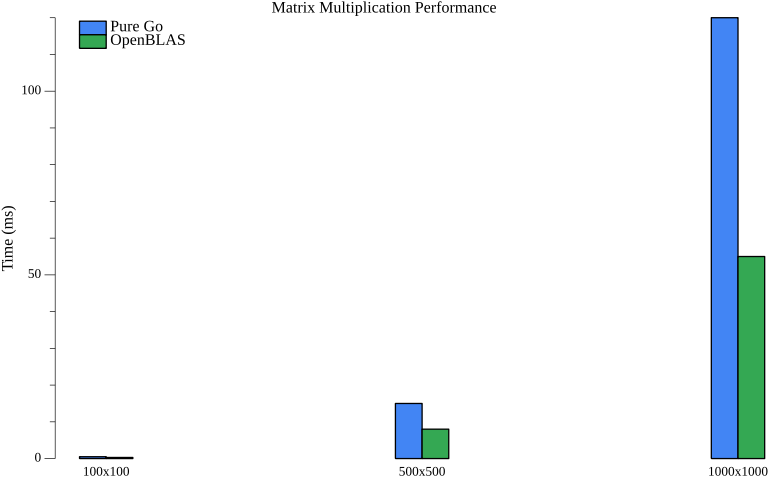
The chart compares pure Go implementation (blue) with OpenBLAS-accelerated operations (green). OpenBLAS provides significant speedups, especially for larger matrices where optimized BLAS routines can leverage SIMD instructions and cache-efficient algorithms.
Performance Tips
1. Choose the Right Data Structure
// Use SymDense for symmetric matrices
sym := mat.NewSymDense(n, data)  // Half the memory

// Use TriDense for triangular matrices
tri := mat.NewTriDense(n, mat.Upper, data)

// Use DiagDense for diagonal matrices
diag := mat.NewDiagDense(n, diagData)

// Use Sparse matrices for sparse data
// (gonum/sparse package)
2. Batch Operations
// Bad: many small operations
for i := 0; i < 1000; i++ {
    v := mat.NewVecDense(n, data[i])
    result[i] = mat.Norm(v, 2)
}

// Good: single large operation
allData := mat.NewDense(1000, n, flatData)
for i := 0; i < 1000; i++ {
    row := allData.RowView(i)
    result[i] = mat.Norm(row, 2)
}
3. Leverage SIMD via BLAS
// These operations use optimized BLAS routines
var result mat.Dense
result.Mul(A, B)        // Uses DGEMM
result.Add(A, B)        // Vectorized
mat.Dot(v1, v2)         // Uses DDOT
Summary
Go with gonum provides a capable platform for numerical computing. For production workloads, use optimized BLAS implementations and leverage Go’s concurrency primitives for parallel operations.
Resources
Linear Algebra: Golang Series - View all articles in this series.
This blog post, titled: "Linear Algebra in Go: High-Performance Computing: Linear Algebra in Go Part 10" by Craig Johnston, is licensed under a Creative Commons Attribution 4.0 International License.
