This article covers eigenvalue problems in Go using the gonum library. Eigenvalues and eigenvectors are fundamental to many algorithms including PCA, spectral clustering, and dynamical systems analysis.
Linear Algebra: Golang Series - View all articles in this series.
Previous articles in this series:
- Linear Algebra in Go: Vectors and Basic Operations
- Linear Algebra in Go: Matrix Fundamentals
- Linear Algebra in Go: Solving Linear Systems
This continues from Part 3: Solving Linear Systems.
Computing Eigenvalues and Eigenvectors
Use mat.Eigen for eigenvalue decomposition:
package main

import (
    "fmt"
    "gonum.org/v1/gonum/mat"
)

func main() {
    A := mat.NewDense(3, 3, []float64{
        4, 2, 2,
        2, 5, 1,
        2, 1, 6,
    })

    // Compute eigendecomposition
    var eig mat.Eigen
    ok := eig.Factorize(A, mat.EigenRight)
    if !ok {
        fmt.Println("Eigendecomposition failed")
        return
    }

    // Get eigenvalues (may be complex)
    eigenvalues := eig.Values(nil)
    fmt.Println("Eigenvalues:")
    for i, ev := range eigenvalues {
        fmt.Printf("  λ%d = %.4f + %.4fi\n", i+1, real(ev), imag(ev))
    }

    // Get eigenvectors
    var vectors mat.CDense
    eig.VectorsTo(&vectors)
    fmt.Println("\nEigenvectors (columns):")
    rows, cols := vectors.Dims()
    for i := 0; i < rows; i++ {
        for j := 0; j < cols; j++ {
            v := vectors.At(i, j)
            fmt.Printf("  (%.4f + %.4fi)", real(v), imag(v))
        }
        fmt.Println()
    }
}
Symmetric Matrices
For symmetric matrices, use mat.EigenSym for better performance and guaranteed real eigenvalues:
func symmetricEigen() {
    // Symmetric positive-definite matrix
    A := mat.NewSymDense(3, []float64{
        4, 2, 2,
        2, 5, 1,
        2, 1, 6,
    })

    var eig mat.EigenSym
    ok := eig.Factorize(A, true)  // true = compute eigenvectors
    if !ok {
        fmt.Println("Eigendecomposition failed")
        return
    }

    // Eigenvalues (guaranteed real for symmetric matrices)
    eigenvalues := eig.Values(nil)
    fmt.Println("Eigenvalues:")
    for i, ev := range eigenvalues {
        fmt.Printf("  λ%d = %.4f\n", i+1, ev)
    }

    // Eigenvectors (orthonormal for symmetric matrices)
    var vectors mat.Dense
    eig.VectorsTo(&vectors)
    fmt.Println("\nEigenvectors:")
    fmt.Printf("%v\n", mat.Formatted(&vectors))
}
Geometric Interpretation
Eigenvectors are special directions that remain unchanged (except for scaling) under the linear transformation. Here’s a visualization using gonum/plot:
package main

import (
    "image/color"
    "math"

    "gonum.org/v1/gonum/mat"
    "gonum.org/v1/plot"
    "gonum.org/v1/plot/plotter"
    "gonum.org/v1/plot/vg"
)

func main() {
    // Matrix with eigenvalues 3 and 1
    A := mat.NewDense(2, 2, []float64{2, 1, 1, 2})

    // Compute eigenvectors
    var eig mat.EigenSym
    eig.Factorize(mat.NewSymDense(2, []float64{2, 1, 1, 2}), true)
    eigenvalues := eig.Values(nil)
    var vectors mat.Dense
    eig.VectorsTo(&vectors)

    p := plot.New()
    p.Title.Text = "Eigenvectors: Scaled but Not Rotated"
    p.X.Label.Text = "X"
    p.Y.Label.Text = "Y"
    p.X.Min, p.X.Max = -3, 3
    p.Y.Min, p.Y.Max = -3, 3

    // Draw each eigenvector and its transformation
    colors := []color.RGBA{
        {R: 66, G: 133, B: 244, A: 255},  // Blue
        {R: 234, G: 67, B: 53, A: 255},   // Red
    }

    for i := 0; i < 2; i++ {
        v := []float64{vectors.At(0, i), vectors.At(1, i)}
        lambda := eigenvalues[i]

        // Original eigenvector
        drawArrow(p, 0, 0, v[0], v[1], colors[i])

        // Transformed: A*v = lambda*v (scaled version)
        drawArrow(p, 0, 0, lambda*v[0], lambda*v[1],
            color.RGBA{R: colors[i].R, G: colors[i].G, B: colors[i].B, A: 128})
    }

    p.Save(6*vg.Inch, 6*vg.Inch, "eigenvalues-geometric.png")
}

func drawArrow(p *plot.Plot, x1, y1, x2, y2 float64, c color.Color) {
    pts := plotter.XYs{{X: x1, Y: y1}, {X: x2, Y: y2}}
    line, _ := plotter.NewLine(pts)
    line.Color = c
    line.Width = vg.Points(2)
    p.Add(line)

    // Arrowhead
    angle := math.Atan2(y2-y1, x2-x1)
    arrowLen := 0.15
    ax1 := x2 - arrowLen*math.Cos(angle-math.Pi/6)
    ay1 := y2 - arrowLen*math.Sin(angle-math.Pi/6)
    ax2 := x2 - arrowLen*math.Cos(angle+math.Pi/6)
    ay2 := y2 - arrowLen*math.Sin(angle+math.Pi/6)

    arrow1, _ := plotter.NewLine(plotter.XYs{{X: x2, Y: y2}, {X: ax1, Y: ay1}})
    arrow1.Color = c
    arrow1.Width = vg.Points(2)
    arrow2, _ := plotter.NewLine(plotter.XYs{{X: x2, Y: y2}, {X: ax2, Y: ay2}})
    arrow2.Color = c
    arrow2.Width = vg.Points(2)
    p.Add(arrow1, arrow2)
}
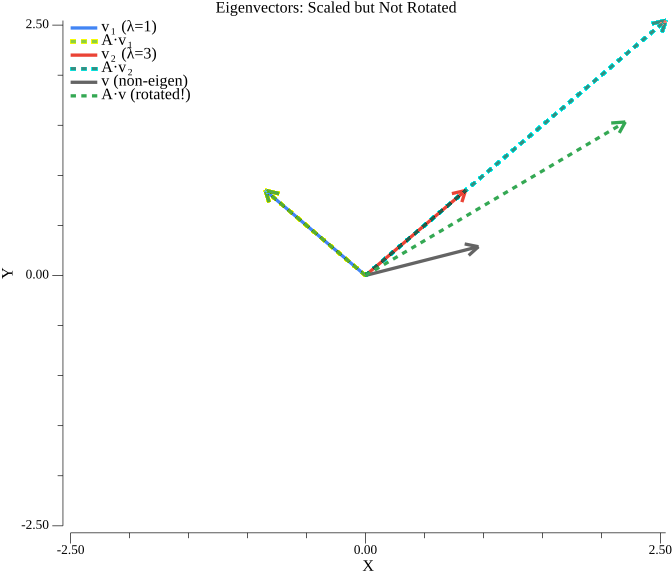
The solid arrows show eigenvectors, and the faded arrows show the result after transformation by matrix A. Notice that eigenvectors only get scaled (by their eigenvalue λ), not rotated. Non-eigenvectors would both rotate and scale.
Verifying Eigenvalue Properties
Verify that eigenvectors satisfy $\boldsymbol{A}\vec{v} = \lambda\vec{v}$:
func verifyEigenproperties() {
    A := mat.NewSymDense(2, []float64{3, 1, 1, 3})

    var eig mat.EigenSym
    eig.Factorize(A, true)

    eigenvalues := eig.Values(nil)
    var vectors mat.Dense
    eig.VectorsTo(&vectors)

    fmt.Println("Verification: A*v = λ*v")
    for i := 0; i < 2; i++ {
        // Extract eigenvector
        v := mat.NewVecDense(2, nil)
        mat.Col(v.RawVector().Data, i, &vectors)

        // Compute A*v
        var Av mat.VecDense
        Av.MulVec(A, v)

        // Compute λ*v
        lambdaV := mat.NewVecDense(2, nil)
        lambdaV.ScaleVec(eigenvalues[i], v)

        fmt.Printf("\nEigenvector %d (λ = %.4f):\n", i+1, eigenvalues[i])
        fmt.Printf("  A*v  = [%.4f, %.4f]\n", Av.AtVec(0), Av.AtVec(1))
        fmt.Printf("  λ*v  = [%.4f, %.4f]\n", lambdaV.AtVec(0), lambdaV.AtVec(1))
    }
}
Power Iteration
Implement power iteration to find the dominant eigenvalue:
func powerIteration(A *mat.Dense, maxIter int, tol float64) (float64, *mat.VecDense) {
    n, _ := A.Dims()

    // Start with random vector
    v := mat.NewVecDense(n, nil)
    for i := 0; i < n; i++ {
        v.SetVec(i, 1.0)
    }

    // Normalize
    norm := mat.Norm(v, 2)
    v.ScaleVec(1/norm, v)

    var lambda float64
    for iter := 0; iter < maxIter; iter++ {
        // Compute Av
        var Av mat.VecDense
        Av.MulVec(A, v)

        // Compute eigenvalue estimate
        lambdaNew := mat.Dot(&Av, v)

        // Normalize
        norm := mat.Norm(&Av, 2)
        Av.ScaleVec(1/norm, &Av)

        // Check convergence
        if iter > 0 && abs(lambdaNew-lambda) < tol {
            return lambdaNew, &Av
        }

        lambda = lambdaNew
        v.CopyVec(&Av)
    }

    return lambda, v
}

func abs(x float64) float64 {
    if x < 0 {
        return -x
    }
    return x
}
Benchmarking vs Python
func benchmarkEigen() {
    sizes := []int{50, 100, 200, 500}

    for _, n := range sizes {
        // Generate random symmetric matrix
        data := make([]float64, n*n)
        for i := 0; i < n; i++ {
            for j := i; j < n; j++ {
                val := float64((i+j)%17) - 8
                data[i*n+j] = val
                data[j*n+i] = val
            }
        }
        A := mat.NewSymDense(n, data)

        start := time.Now()
        var eig mat.EigenSym
        eig.Factorize(A, true)
        elapsed := time.Since(start)

        fmt.Printf("Size %4d: %v\n", n, elapsed)
    }
}
Summary
This article covered:
- General eigendecomposition with
mat.Eigen - Symmetric eigendecomposition with
mat.EigenSym - Verifying eigenproperties
- Power iteration for dominant eigenvalue
- Performance benchmarking
Resources
Linear Algebra: Golang Series - View all articles in this series.
This blog post, titled: "Linear Algebra in Go: Eigenvalue Problems: Linear Algebra in Go Part 4" by Craig Johnston, is licensed under a Creative Commons Attribution 4.0 International License.
